


TLDR: Raynaud's attacks happen when small blood vessels in the fingers overreact to cold or stress and clamp down, turning skin white, blue, then red. Loose, insulated mittens for Raynaud's syndrome trap more heat than gloves. Pair them with whole-body warmth, warm (not hot) water during attacks, quitting smoking, and a doctor's check if sores appear.
What is Raynaud's syndrome?
Raynaud's syndrome refers to episodes in which the small arteries feeding your fingers and toes narrow too far in response to cold or stress, cutting blood flow until the skin turns pale, numb and cold. The spasm eases once you warm up or calm down, sometimes within minutes, sometimes over a couple of hours.

If you've ever grabbed a bag of frozen peas and watched two fingertips go chalk-white while the rest of your hand looked normal, you already know the feeling. The fingers go dead. Then they throb as blood forces its way back. People who live with this get tired of hearing "just wear gloves," because ordinary gloves often can't hold enough heat. That frustration sends a lot of people searching for mittens for Raynaud's syndrome in the first place.
Doctors call the narrowing a vasospasm. You'll also see the condition listed as Raynaud's disease, Raynaud's phenomenon or Raynaud syndrome. Prevalence figures depend on the study: the US-based Raynaud's Association puts it at 5% to 10% of Americans, and a systematic review and meta-analysis found primary Raynaud's in about 4.85% of people. According to Mayo Clinic, women get it more often than men, and it shows up more in colder climates.
October happens to be Raynaud's Awareness Month in the US. For most people, that lines up with the first cold mornings of the season.
What causes Raynaud's attacks?
Raynaud's attacks start when blood vessels in the fingers and toes overreact to cold or emotional stress and narrow sharply. Cold air, cold water and touching frozen food set off most attacks. Smoking, some medicines, vibrating tools, and conditions such as scleroderma or lupus can also drive them.
Researchers still haven't pinned down exactly why some people's vessels react this hard. Mayo Clinic describes the vessels in the hands and feet as overreacting, and notes that over time those small vessels can thicken slightly and restrict flow even more.
Triggers worth tracking:
- Cold contact. Reaching into the freezer, holding an iced drink, rinsing vegetables under the cold tap.
- Temperature swings. Stepping from a heated house into winter air, or walking into an over-chilled office in July. The NHS specifically advises avoiding sudden temperature changes.
- Stress and anxiety. Stress activates the same nerve pathway that tightens vessels in the cold, so a tense meeting can whiten your fingers in a warm room.
- Nicotine and caffeine. Smoking narrows blood vessels, and the NHS lists too much caffeine (tea, coffee, cola, chocolate) as a possible trigger.
- Certain medicines. Mayo Clinic names beta blockers, some migraine drugs, ADHD medicines, certain cancer drugs and some cold medicines.
- Hand strain. Years of vibrating tools, or long stretches of repetitive work such as typing or playing piano.
If you take any of those medicines, don't stop them on your own. Ask whoever prescribed them whether an alternative makes sense for you.
What does a Raynaud's attack look and feel like?
A typical Raynaud's attack turns the affected fingers white first, then blue, then red as blood returns, with numbness, pins and needles, or a throbbing ache along the way.
Not everyone sees all three colors. Some people only go white. On brown or black skin, the NHS notes that the fingertips may simply look paler than the rest of the hand, which makes attacks easier to miss.

Timing varies a lot. The NHS says symptoms can last from a few minutes to a few hours, and Mayo Clinic adds that once you warm up, full blood flow can take around 15 minutes to come back.
Here's the part nobody warns you about: the rewarming stage often hurts more than the cold stage. As blood rushes back, fingers sting, swell and throb. Fingers and toes take most of the hits, though ears, nose, lips and nipples can react too.
Primary vs. secondary Raynaud's: what's the difference?
Primary Raynaud's happens on its own with no underlying disease, while secondary Raynaud's develops because of another condition, most often an autoimmune or connective tissue disease such as scleroderma, lupus, rheumatoid arthritis or Sjögren's syndrome.
Primary Raynaud's makes up roughly 80% to 90% of cases, according to the Merck Manual. It usually begins between ages 15 and 30, tends to stay mild, and sometimes fades without medical help.
Secondary Raynaud's typically starts later, around age 40 per Mayo Clinic, and runs more serious. Most people with scleroderma have it. Beyond autoimmune disease, carpal tunnel syndrome, years of vibrating tools, hand injuries, frostbite, smoking, certain medicines and chemicals such as vinyl chloride can set it off. In severe secondary cases, poor blood flow can cause painful fingertip ulcers and, rarely, gangrene.
This split changes what you need. With mild primary Raynaud's, good mittens and a few habit changes often cover it. Secondary Raynaud's calls for a rheumatologist, and mittens become one tool among several. If you already live with rheumatoid arthritis or lupus and notice cold-triggered color changes, bring them up at your next appointment.
Is it Raynaud's or something else?
Raynaud's differs from ordinary cold hands because it causes sharp, well-defined color changes in specific fingers that reverse once you warm up. Numbness without any color change, or itchy swelling that gets worse with warmth, usually points to a different problem.
Use this table as a rough guide, not a diagnosis:
| Condition | Where it shows up | Telltale sign | Typical trigger |
|---|---|---|---|
| Primary Raynaud's | Fingers on both hands, toes; sometimes nose and ears | White or blue patches with clear edges, then red and throbbing on rewarming | Cold, sudden temperature drops, stress |
| Secondary Raynaud's | Fingers and toes, sometimes uneven between sides | Same color changes, often starting after 30, sometimes with joint pain, rash, tight skin or fingertip sores | Cold and stress, on top of scleroderma, lupus, rheumatoid arthritis or Sjögren's |
| Chilblains | Fingers and toes | Burning, itchy, red or purple swelling that gets worse as you warm up | Cold exposure followed by rewarming |
| Hand-arm vibration syndrome | Fingers of the hand that holds the tool | White fingers plus tingling, numbness and a weaker grip | Years of using vibrating tools |
| Carpal tunnel syndrome | Thumb, index, middle and half of the ring finger | Numbness and tingling, often worse at night, with no crisp color change | Pressure on the median nerve at the wrist |
| Hyperventilation | Both hands | Pins and needles and trembling, but fingers keep their normal color | Breathing too fast, often from anxiety |
| Everyday cold hands | Whole hand | Hands feel cold but keep an even color | Cold weather |
Two of these overlap with Raynaud's more than people expect. Carpal tunnel syndrome can make a hand react more strongly to cold, and long-term vibration exposure can cause Raynaud's directly. If your symptoms fit more than one row, a doctor can sort it out with an exam and, sometimes, a blood test.
Why are mittens better than gloves for Raynaud's?
Mittens keep fingers warmer than gloves because all four fingers share one insulated pocket, warming each other and losing less heat through less exposed surface.
Gloves wrap each finger on its own. That spreads your hand's heat across more fabric and more surface touching cold air. During a Raynaud's attack your fingers produce very little warmth, so the shared heat inside a mitten makes a real difference.
Patient guides from clinical groups agree. The Johns Hopkins Scleroderma Center tells patients to wear mittens instead of gloves, the Lupus Foundation of America gives the same advice, and a certified hand therapist writing for the American Society for Surgery of the Hand notes that mittens tend to keep hands warmer than fingered gloves.
The honest downside: you lose dexterity. Texting, zipping a coat or gripping a cold steering wheel gets clumsy in thick mittens. A few workarounds help:
- Wear a thin liner underneath. Scleroderma & Raynaud's UK (SRUK) suggests thin cotton or silk gloves under thicker mittens for added warmth. The liner also lets you slip a mitten off for 30 seconds without bare skin meeting cold air.
- Try flip-top mittens. A fold-back mitten cap over fingerless gloves gives quick fingertip access, and the ASSH hand therapist suggests this style for indoor wear as well.
- Double up on bitter days. Mayo Clinic suggests two sets of mittens or gloves in cold weather.
- Warm the car first. Run the heater for a few minutes before you drive, so you need less bulk on your hands at the wheel.
What should you look for in mittens for Raynaud's syndrome?
The best mittens for Raynaud's syndrome fit loosely, cover your wrists, block wind and water, and leave room for a liner or a hand warmer.
- A loose fit. SRUK warns that tight clothing may restrict blood flow, and that applies to mittens too. You should be able to make a full fist inside without the fabric pulling.
- Long cuffs. Cold wrists chill the blood on its way to your fingers. Mayo Clinic recommends coats with cuffs that close around your mittens or gloves.
- A windproof, water-resistant shell. Wind strips heat fast, and damp insulation loses much of its warmth.
- Insulation that copes with moisture. Wool, fleece and synthetic fills handle a little dampness better than cotton.
- Space for a warmer or heat pack. Some mittens have a zip pocket on the back of the hand; others just have enough room to slip one in.
- Easy on, easy off. If they're a fight to put on, you'll skip them for "quick" trips outside, and short trips can still set off an attack.
One habit matters as much as the mitten itself. Put them on before you go outside, while your hands are still warm. Keeping fingers warm takes far less effort than rewarming them once an attack starts, and some people with Raynaud's pre-warm their mittens on a radiator or with a heat pack before heading out.
Heated or insulated mittens: which do you need?
Insulated mittens only hold in the heat your hands already make, while heated mittens add warmth from a battery, a microwavable pad or a chemical warmer. That difference matters during an attack, when your fingers have almost no heat left to hold.

Here's how the main types compare in practice:
- Insulated mittens (no heat source). Cheapest and lightest, with nothing to charge. They work well for prevention if you put them on with warm hands, but they can't rewarm fingers that have already gone white.
- Battery-heated mittens. Steady heat for long stretches outdoors, which suits skiing, dog walks or outdoor work. Expect more weight, a higher price and batteries to charge. Results vary from person to person.
- Microwavable heat-pad mittens. Good for rewarming at home, easing stiff hands in the morning, and pre-warming before you leave. The heat fades as the pads cool, so they don't suit a long walk.
- Disposable chemical hand warmers. Cheap and easy to tuck into any roomy mitten. They can run hot, so keep fabric between the warmer and your skin.
One safety point covers every heated option. Numb fingers can't judge temperature well, which raises the risk of burns. Test any heat source on the inside of your wrist first, and don't fall asleep with a heat pack pressed against bare skin.
How do you stop a Raynaud's attack fast?
To stop a Raynaud's attack, get out of the cold and rewarm your hands gradually: run them under warm (not hot) water, tuck them into your armpits, or swing your arms in big circles to push blood back toward your fingertips.
- Move somewhere warmer, or at least out of the wind.
- Run warm water over your hands. Warm, not hot. Numb skin burns easily, and some people find very hot water brings on chilblains.
- No sink nearby? Tuck your hands into your armpits, or sit on them.
- Windmill your arms. Swing them in large circles at your sides. Kaiser Permanente's patient instructions recommend this to increase blood flow to the hands.
- Wiggle and rub your fingers once some feeling comes back.
- Slow your breathing if stress set off the attack.
Expect the red, throbbing stage as circulation returns. It should settle as the color evens out. If one fingertip stays white or blue, or turns dark, after the rest of your hand recovers, get medical advice the same day.
How can you prevent Raynaud's attacks day to day?
Preventing Raynaud's attacks comes down to keeping your whole body warm, not just your hands, and cutting back on things that tighten blood vessels, such as smoking, excess caffeine and certain medicines.
Core temperature drives a lot of this. The ASSH hand therapist explains that the Raynaud's response kicks in when your whole body gets cold, even if your hands and feet feel fine. A hat, a scarf and a warm base layer often do as much for your fingers as the mittens do.
Small changes around the house add up:
- Keep a pair of mittens or oven mitts next to the fridge for freezer trips, as Mayo Clinic suggests.
- Drink cold drinks from insulated cups.
- Set the air conditioning a few degrees warmer in summer.
- Carry shopping bags in your arms rather than by the handles. Narrow handles squeeze the fingers and cut circulation.
- Loosen tight rings and watch straps on cold days.
- Wear loose mittens and socks to bed in winter if cold hands wake you up.
- Eat a hot meal or have a warm drink before you head out.
Beyond the house, the NHS recommends regular exercise for circulation, breathing exercises or yoga for stress, and quitting smoking. When symptoms stay bad despite all of that, a doctor may prescribe a medicine such as nifedipine, a calcium channel blocker that relaxes blood vessels. The NHS notes that some people take it daily and others only during cold weather.
Do compression gloves help Raynaud's?
Compression gloves don't stop the blood-vessel spasms behind Raynaud's, and tight ones can restrict circulation further. A light, well-fitted, full-finger pair can still help as a thin warm layer, especially for people who also have arthritis.

Compression gloves started as an arthritis tool. Gentle pressure helps some people with swelling and stiffness in the finger joints. Raynaud's works differently: the problem sits in small arteries clamping down, and squeezing the hand doesn't open them. SRUK's advice to avoid tight clothing applies here.
That doesn't make them useless. A thin, full-finger glove adds warmth indoors, covers the fingertips while you type, and fits under a mitten as a liner. For people with secondary Raynaud's on top of rheumatoid arthritis or osteoarthritis, one glove can ease joint stiffness and add a little warmth at the same time.
Watch for signs a pair fits too tightly:
- Fingertips that turn pale or tingle while you wear them
- Deep marks at the wrist or between the fingers
- An ache that builds the longer you keep them on
- Hands that feel colder with the gloves than without
Any of those means size up or take them off. Skip open-finger styles if Raynaud's is your main problem, since fingertips usually take the worst of an attack. And some compression gloves contain copper; good evidence that copper itself improves circulation is lacking, so judge any pair on fit and coverage.
Dr. Arthritis heated mittens: who they suit and where they fall short
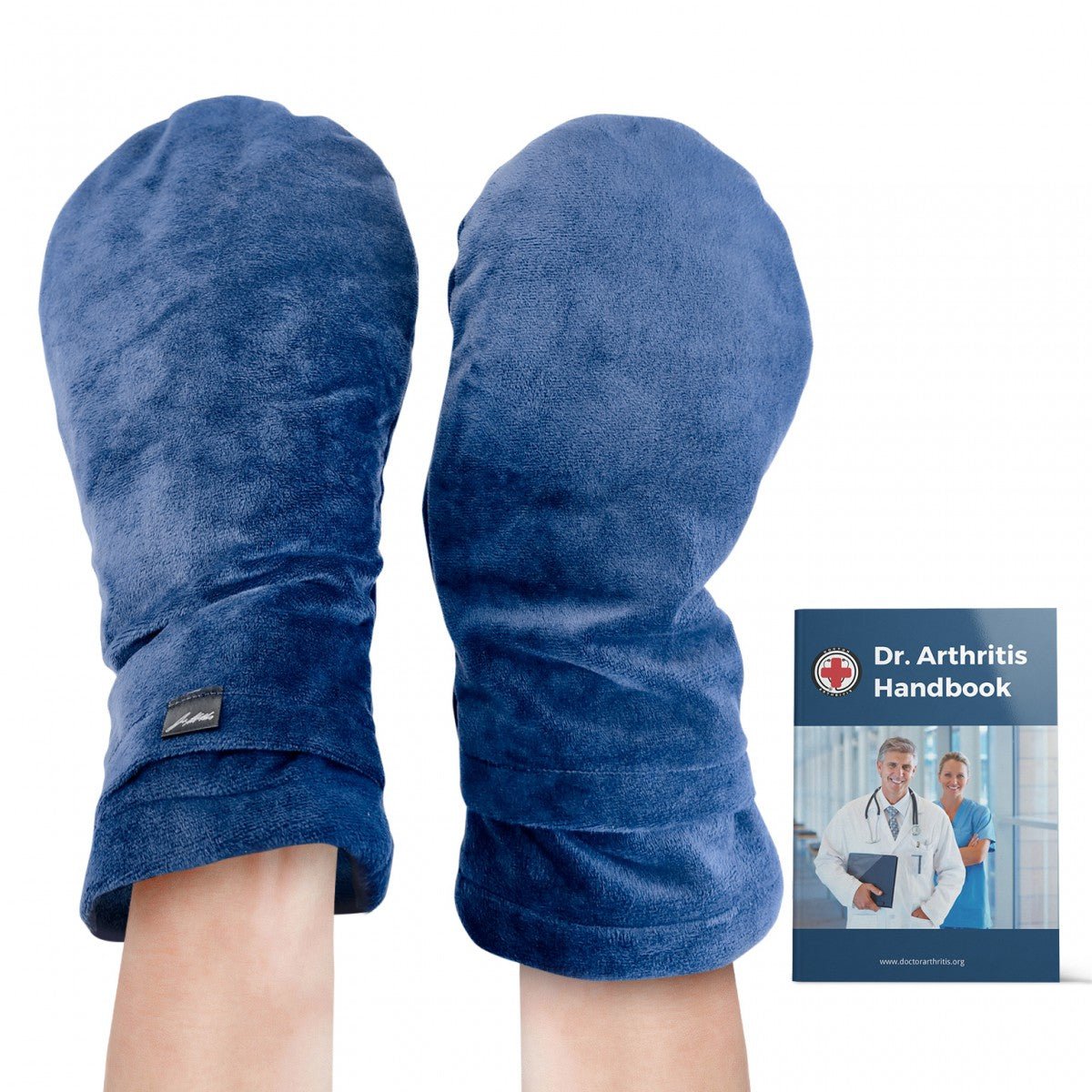
The Dr. Arthritis Heated Mittens hold microwavable, lavender-scented heating pads in slots inside the mitten, which makes them a home-rewarming and heat-therapy tool rather than outdoor winter mittens.
Two practicing medical doctors founded Dr. Arthritis, and the brand designed these mittens for heat therapy in arthritis, muscle stiffness and carpal tunnel syndrome. For Raynaud's, the useful part comes from pairing a mitten shape with an added heat source, which is exactly what cold, spasming fingers lack.
Where they work well
- Rewarming after you come in from the cold, when you want steady, gentle heat instead of standing at the tap
- Pre-warming your hands for a few minutes before you go out, so your walk starts with warm fingers
- Stiff mornings, if you have arthritis alongside Raynaud's
- Evenings on the couch in a chilly house
Where they fall short
- The pads cool over time, so they won't carry you through a long walk. How long the pads hold heat: info pending.
- You need a microwave to heat the pads.
- The product page describes them as heat-therapy mittens, not windproof or waterproof winter wear, so keep a weatherproof pair for snow and rain.
- The lavender scent won't suit everyone.
- At least one reviewer on the official store found the pads sat awkwardly inside the mitten, so check the fit when yours arrive.
At the time of writing they cost $31.95 on the official store, come in blue or pink, fit most hand sizes, use washable materials and include the Dr. Arthritis Handbook. Before sliding numb fingers in, test the warmed pad against your inner wrist, and follow the heating time in the product instructions.
Dr. Arthritis compression gloves: who they suit and where they fall short
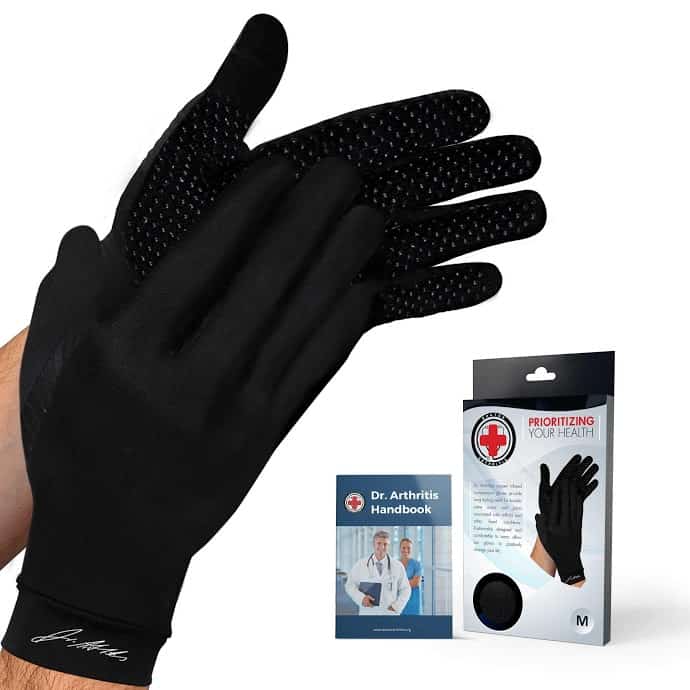
The Dr. Arthritis Copper Compression Gloves (Full-Fingered) suit people who have arthritis alongside Raynaud's and want a thin, full-coverage layer for indoor wear or as a liner under mittens.
The full-finger design matters here. Unlike open-finger compression gloves, these cover the fingertips, where Raynaud's usually hits hardest. The product page lists Raynaud's phenomenon among the conditions the gloves target, along with osteoarthritis, rheumatoid arthritis and carpal tunnel syndrome.
Where they work well
- A liner under loose mittens outdoors, so you can pull a mitten off for a minute without bare skin hitting cold air
- Typing or desk work in a cool office
- A barrier between your fingers and cold surfaces like a phone case or steering wheel
- Daytime joint stiffness and swelling from osteoarthritis or rheumatoid arthritis
Where they fall short
- Compression won't open spasming arteries, and these gloves alone won't stop an attack.
- They're thin. On their own, they won't keep you warm outdoors in winter.
- Fit decides everything with Raynaud's. Reviewers disagree on sizing, with some finding them snug and others finding the wrist loose, so measure against the size chart and choose the larger size if you land between two.
- The fabric blends copper with nylon and spandex. Buy them for fit and finger coverage, not for the copper.
At the time of writing they cost $17.95, come in sizes S through XL, include the Dr. Arthritis Handbook, and carry more than 1,700 customer reviews on the official store.
Deciding between the two? Pick the heated mittens if your worst moments happen at home or first thing in the morning. Pick the compression gloves if you need finger coverage while you work. If you have both arthritis and Raynaud's, they pair well: gloves as a daytime liner, mittens for rewarming in the evening. Neither one replaces a good insulated pair for outdoors.
When should you see a doctor about Raynaud's?
See a doctor if Raynaud's symptoms first appear after age 30, affect only one side of your body, come with joint pain, rashes or muscle weakness, or if you develop a sore or infection on a finger or toe.
Most primary Raynaud's stays a nuisance rather than a danger. These signs suggest something more is going on:
Book an appointment if you notice:
- Symptoms that start for the first time after age 30
- Attacks on only one side of your body, or in a single finger
- Joint pain, skin rashes or muscle weakness alongside the color changes
- Skin on your fingers that feels tight, thick or shiny
- Symptoms that feel very bad, keep getting worse, or disrupt daily life
- Raynaud's symptoms in a child under 12
Get medical help promptly if:
- A sore, ulcer or infection appears on a fingertip or toe
- A finger stays white or blue, or turns dark or black, and doesn't recover after warming
- Severe pain doesn't ease as the finger warms up
A doctor can usually tell primary from secondary Raynaud's with an exam, a blood test for antinuclear antibodies, and sometimes a close look at the tiny blood vessels at the base of your nails (nailfold capillaroscopy). As the note at the bottom of this page says, this guide offers general information and doesn't replace advice from your own doctor.
Ready to Keep Your Fingers Warmer This Winter?
Dr. Arthritis makes heated mittens and full-finger compression gloves developed by practicing doctors for hands that react badly to cold and stiffness. The company reports more than 1 million orders shipped, and its full-fingered compression gloves alone carry over 1,700 reviews on the official store. Warmer winter mornings start with mittens that fit loosely and a liner that doesn't squeeze.
Free shipping on orders over $30 and easy 30-day returns.
Store Information
Both the official website and Amazon offer convenient purchasing options for Dr. Arthritis.
Frequently Asked Questions
Are mittens or gloves better for Raynaud's?
Mittens are better for Raynaud's because your fingers share one warm pocket instead of losing heat through separate finger sleeves. If you need dexterity, wear thin full-finger liner gloves underneath so you can slip a mitten off for a minute without exposing bare skin. The Dr. Arthritis full-fingered compression gloves work as a liner if you choose a size that doesn't squeeze.
Do heated mittens help with Raynaud's?
Yes, heated mittens can help with Raynaud's because they add warmth your fingers can't produce during an attack, but the type matters. Battery-heated mittens suit long stretches outdoors. Microwavable versions such as the Dr. Arthritis Heated Mittens suit rewarming at home and easing morning stiffness. Test any heat source on your inner wrist first, since numb fingers can't judge temperature.
Can compression gloves make Raynaud's worse?
Yes, compression gloves can make Raynaud's worse if they fit too tightly, because pressure on the hand and wrist can restrict blood flow further. Choose a light, full-finger pair, go up a size if you land between two, and take them off if your fingertips turn pale, tingle or ache. A well-fitted pair like the Dr. Arthritis full-fingered gloves works best as an indoor layer or a liner under mittens.
Should I wear gloves to bed with Raynaud's?
Wearing loose mittens or soft gloves to bed can help Raynaud's in cold months, and Mayo Clinic notes that some people find mittens and socks at night helpful. Pick a breathable pair with nothing tight at the wrist, and never sleep with a heat pack pressed against your skin. You can browse options in the Dr. Arthritis Raynaud's syndrome collection.
Is Raynaud's syndrome serious?
Primary Raynaud's usually isn't serious and rarely causes lasting damage, but secondary Raynaud's can be, because it often comes with an autoimmune disease and can lead to fingertip ulcers. See a doctor if symptoms start after age 30, affect one side of your body, or come with joint pain, rashes or sores. Good mittens from Dr. Arthritis or anywhere else help with comfort, but they don't replace a medical assessment.